
Meet MeasureLab
Turn any table to a science Lab
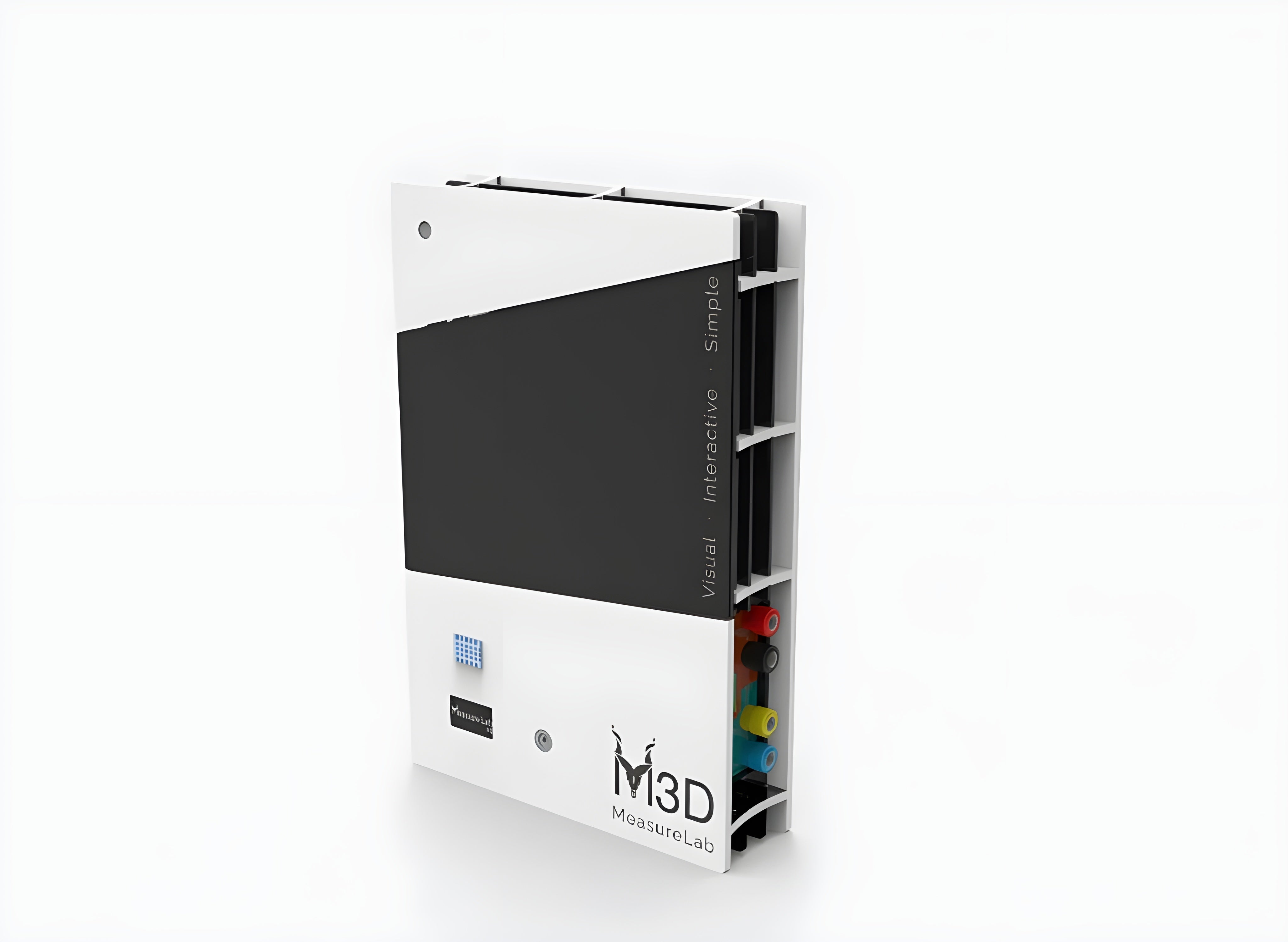
Feature List
Here' a brief walk through of what MeasureLab is and what it is capable of

12+ Sensors
Pair large text with an image to give focus to your chosen product, collection, or blog post. Add details on availability, style, or even provide a review.

Plug and Play
Pair large text with an image to give focus to your chosen product, collection, or blog post. Add details on availability, style, or even provide a review.

Live Plot
Pair large text with an image to give focus to your chosen product, collection, or blog post. Add details on availability, style, or even provide a review.

Built-in Display
Pair large text with an image to give focus to your chosen product, collection, or blog post. Add details on availability, style, or even provide a review.

Advance Controls
Pair large text with an image to give focus to your chosen product, collection, or blog post. Add details on availability, style, or even provide a review.
What Does MeasureLab Accomplish?
✅ Science Lab Goes Digital
Instant data visualization with digital sensors simplifies teaching and sparks student curiosity.
✅ Plug-and-Play Hardware & Intuitive Software
Eliminate the need for specialized training or complex setups.
✅ Inspired by Popular Curricula
Easily integrates into existing lesson plans and teaching schedules.
✅ Affordable & Low Maintenance
A cost-effective solution that maximizes value for both schools and parents.
✅ Collaborative Learning Focus
Designed for small groups, encouraging hands-on exploration, teamwork, and critical thinking.
What’s Inside MeasureLab
A quick, friendly tour of built-ins, outputs, plug-and-play probes, and handy apparatus.
Built-In Sensors
- Voltage (±10 V ×3) — Measure varying electrical potentials for circuit experiments.
- Ambient Light Sensor — Detect and quantify light intensity.
- Mass Sensor — Weigh objects easily for physics or chemistry labs.
- Force Sensor — Track pushes and pulls for motion and pressure studies.
- Heartbeat Monitor — Observe heart rate in real time.
- Temperature & Humidity Sensor — Capture environmental conditions instantly.
- Noise Level Meter — Measure sound intensity across different settings.
- Altitude Sensor — Monitor changes in height or pressure for atmospheric experiments.
- Gauge Pressure Sensor — Precisely measure internal and external pressures.
On-Device Outputs
- Voltage Output (±10 V) — Supply adjustable electrical signals for experiments.
- Stepper Motor — Control rotations for robotics, mechanics, or motion studies.
- Onboard Screen Display — View essential readings and data directly on the device.
Plug-and-Play Probes
- Magnetic Flux Sensor — Study magnetic fields and how they change.
- Environmental Pollution Sensor (CO, CO₂, Alcohols) — Monitor air quality for real-time pollution tracking.
- Light ToF Distance Sensor — Measure contactless distances with precision.
- Fan Module — Explore airflow, aerodynamics, or cooling experiments.
- Speaker — Demonstrate sound waves, frequencies, and alerts.
- Motors (Additional) — Add motion to experiments, from simple rotations to robotics.
- Solar Cell — Investigate renewable energy and light-to-electricity conversion.
- 2× Photogates — Measure speed, acceleration, and timing in motion experiments.
Apparatus Extensions
- 2× Lab Stands — Secure sensors, pulleys, or other equipment.
- USB/Power Cables — Quick setup and reliable power connections.
- Banana Cables — Simple, safe wiring for electrical experiments.
- Containers & Tubing/Connectors — Ideal for fluid, pressure, or chemical demos.
- Slotted Weights & 2× Pulley Sets — Essential for force, motion, and mechanics investigations.
Pair sensors with plug-and-play probes to design complete experiments in minutes.


Curriculum
Unlock the full potential of M3D’s equipment with our comprehensive curriculum and lesson plans.| Pillar | What It Means | Why It Matters |
|---|---|---|
| Teacher-Centric | Intuitive equipment, straightforward setup, and ready-to-use lesson plans. | Reduces educator workload by eliminating steep learning curves or extensive training. |
| Practical-First, Theory-Follows | Hands-on exploration comes first, while theory reinforces what students discover. | Promotes active learning and helps students retain concepts longer. |
| Improved Student Engagement & Concepts | Interactive experiments with real-time data, designed for teams of 3–5 students. | Makes science tangible, engaging, and accessible for different learning paces. |